Search This Blog

Sunday, June 12, 2011

Vancouveria hexandra


Vancouveria hexandra, Inside Out Flower, is a noteworthy N.W. native woodland groundcover.  It has pretty green foliage with interesting ternate leaves, giving it another common name, Duck’s Foot.  The delicate sprays of distinctive white flowers in late spring resemble it’s close relative, Epimedium.  Both are herbaceous members of the barberry family that also gives us other interesting genera including Podophyllum and Jeffersonia.

Inside out flower resembles a shooting star 

Vancouveria hexandra is found at low to mid elevations in our local forests and is a tough and adaptable perennial.  Often evergreen in mild winter conditions, it is deciduous when grown in colder weather .  It is also quite cold hardy and is reported to thrive in gardens in Pennsylvania and Vermont, far from its Pacific NW native habitat.


Vancouveria hexandra spreads slowly by underground rhizomes to form a charming groundcover to 18” tall.  Grow in part to full shade in humus rich, moist to dry soil.  Because of its drought tolerance, it is a welcome addition to our dry shade garden.

Dry shade garden with Menziesia ferruginea

Available now at the nursery.  We also expect to offer it in our 2012 online mail order catalog.

Friday, June 3, 2011

Summer Classes


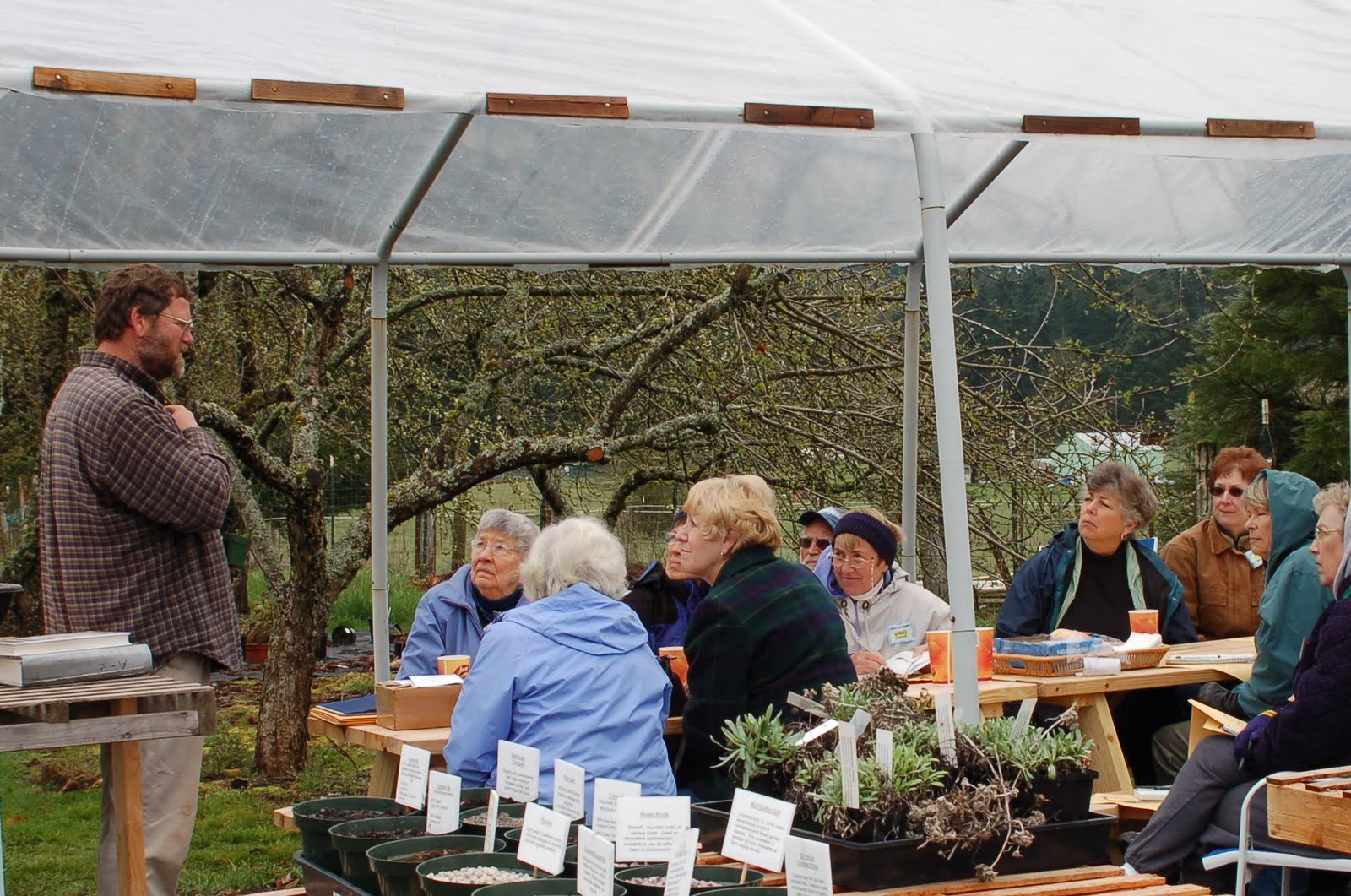
We are offering a series of classes at the nursery this season. 

The first class “ Western Native Plants” is scheduled for Saturday, June 11th at 1 pm.  We will be taking a closer look at the definition of native plants and how to evaluate your garden situation and select appropriate plants for it.  Site preparation, ongoing care and maintenance issues will also be discussed.  Of course, we will be sharing some of our favorites and we encourage participants to bring their questions!

Another class will be held on Saturday, June 25th at 1 pm and is entitled “Alpines”.  This class will focus on our wide selection of dwarf and miniature plants suitable for troughs and containers, alpine gardens and other small garden spaces. 

“Rock Garden Techniques” - Saturday, July 9 at 1 pm
During this class, we will focus on specific techniques for creating and planting rock crevices.  Plants growing in crevices are some of the most attractive areas in alpine gardens, rock walls and even containers.  We will show how these spaces are created and discuss plant choices.

“Plant a Succulent Container” - Saturday, August 13 at 1 pm
Create a succulent garden in a container.  Bring your own trough or other container or purchase one here.  $15 fee includes potting mix, accent rocks and three plants.

“Late Season Flowers” - Saturday, September 24 at 1 pm
This class will focus on late flowering perennials that extend the gardening season while supporting our bird and insect populations. 

“Perennial Seed Propagation” - Saturday, October 8 at 1 pm
During this hands-on class, participants will have an opportunity to harvest and sow seeds of hardy perennials.  We will discuss how to store seed, when to sow and how to handle perennial seedlings.

We hope you will join us for one or more of these topics.  Please RSVP.

Saturday, May 28, 2011

Lewisia cotyledon


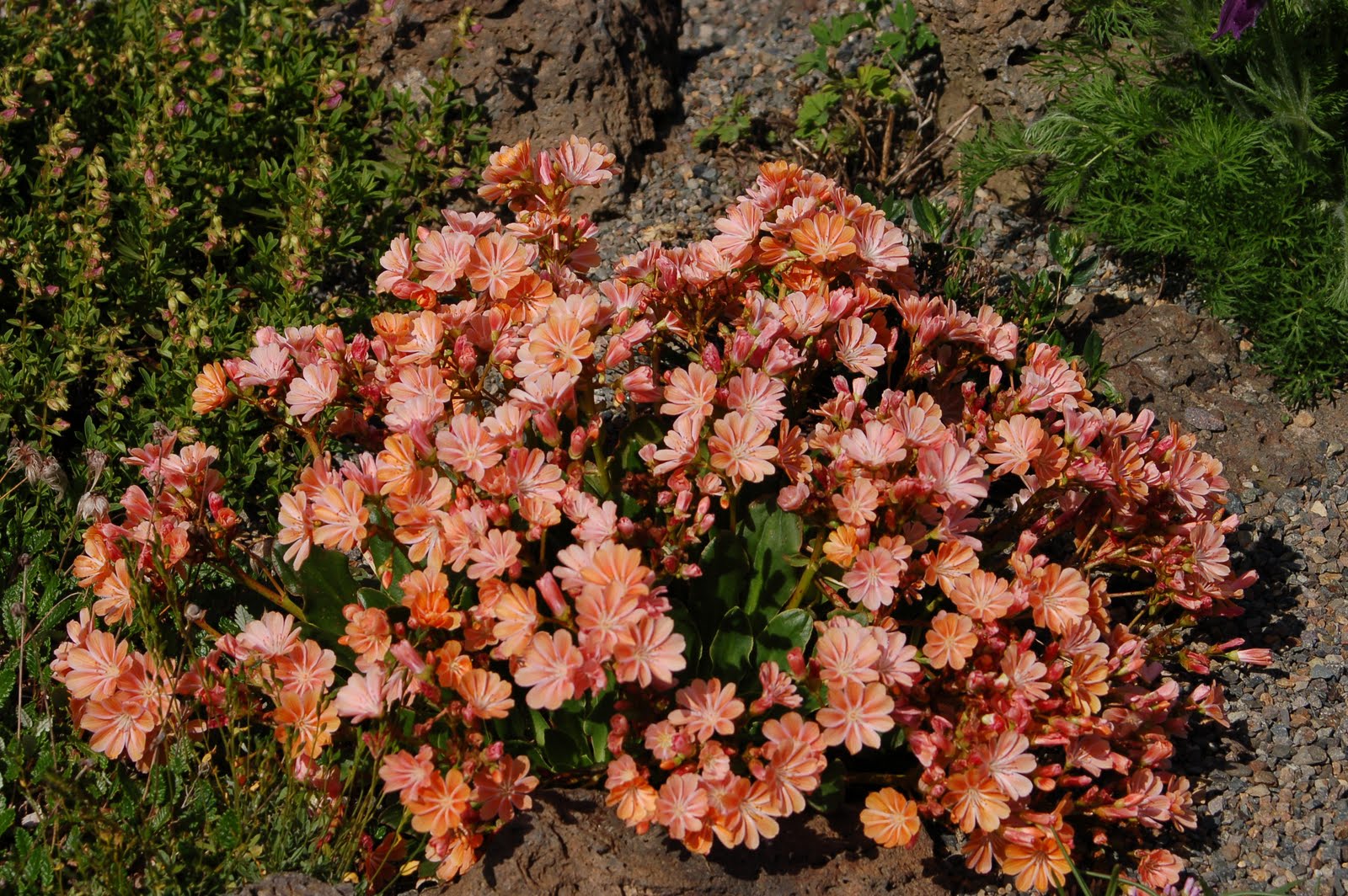
Lewisia cotyledon is a spring flowering, evergreen succulent found in the Siskiyou Mountains of Southern Oregon and Northern California.  Vigorous hybrid varieties have been developed with colorful spring flowering displays and an extended flowering period.

Lewisia mound in rock garden

Lewisias are found in rocky crevices in nature and work well in alpine gardens, scree beds, tucked into rock walls and in raised beds.  They also make attractive, long-lived container plants.

Lewisia cotyledon in scree
Lewisia cotyledon should be grown in very well-drained, low fertility soil and do best in Western climates where humidity is low during the summer months.  Although they can grow happily in full sun, the blooming period is prolonged if given some afternoon shade.  Their fleshy, succulent leaves make them drought tolerant but they benefit from some rainfall or irrigation during the flowering period.
Lewisia cotyledon 'Sunset Strain'

Customers occasionally report that the foliage at the base of their plants has turned yellow.  This situation can be caused by a variety of factors:

1. It can be a natural process as new leaves are formed toward the center of the rosette and the older, outer foliage turns yellow, leathery and eventually dries up.  In assessing how a plant is doing, we look at the health of the central leaves.  If they are plump, green and healthy, the plant is usually OK.

2. Any soft, mushy leaves and especially mushiness at the base of the Lewisia is a sign of moisture related problems.  If plants end up dying with the plants "popping off" at soil level, they have probably been over watered and/or the soil is too heavy.  Excessive moisture can cause crown rot.  Under watered plants just become more leathery, lose turgor and don't flower as well.  It is better to underwater than overwater.

3.  Another possibility is that the soil is too rich.  If Lewisias are grown in too fertile soil they may be more likely to have what we call a "long neck" from overgrowth.  The foliage at the base of the plant dies off, leaving the central caudex exposed.  It can be unsightly and these plants are probably not as long lived as those grown in poor soils. 
Lewisia cotyledon var purdyi

Add inorganic soil amendments such as crushed rock and sand to heavy soils.  This has the dual benefit of improving drainage and decreasing soil fertility.
Lewisia cotyledon 'Rainbow Strain'

Friday, May 13, 2011

Summer Nursery Hours

Whew! We survived another hectic spring plant sale season with off site plant sales nearly every week.  Each spring we look forward to these sales but after six extremely busy weeks, it is also fun to have more nursery time.
Wild Ginger Farm nursery
 It should be a good year at the nursery.  We have lots of new plants in propagation and some will be ready for sale within a few weeks.  The gardens are beginning to wake up and we look forward to sprucing them up during the coming weeks.  Two of our most popular garden areas, the Lewisia mound and the miniature conifer rock garden already look great.  
Lewisia longipetala x cotyledon

The Lewisia have been slowed by our cold spring weather but are finally coming into flower.  At the nursery, we offer a number of Lewisia species and hybrids including Lewisia cotyledon, Lewisia pygmaea, Lewisia nevadensis and the extremely rare Lewisia glandulosa.  We also have a pretty Lewisia longipetala x cotyledon hybrid that is a beautiful trough addition.
Arisaema erupting

Arisaema speciosum v mirable

Many woodland plants are at their peak in spring and early summer.  The strange and wonderful Arisaema are rising from the ground with the promise of their cobra like flowers and striking foliage.  We are even seeing the earliest members of the hardy ginger family, Roscoea and Cautleya, begin to send out new shoots.  It won’t be long before we see their bright and colorful flowers.  And we have a fabulous selection of the famous Himalayan Blue Poppy ready for sale at the nursery.
Gorgeous Himlayan Blue Poppies including this Meconopsis 'Lingholm'

We plan a series of classes at the nursery this summer beginning on June 11th when our focus will be on Western native perennials.  I’ll blog in more detail about this later.  You can always check the Wild Ginger Farm homepage for our current open hours and event schedule. 
An alpine primula, Primula rusbyi

Throughout the summer, the nursery will be open to the public on Friday, Saturday and Sundays from 10 am to 4.  We hope you will stop in and say hello!